Description
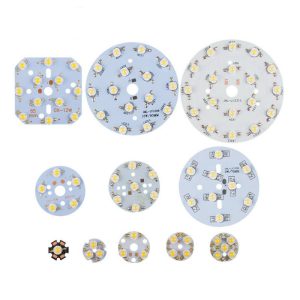
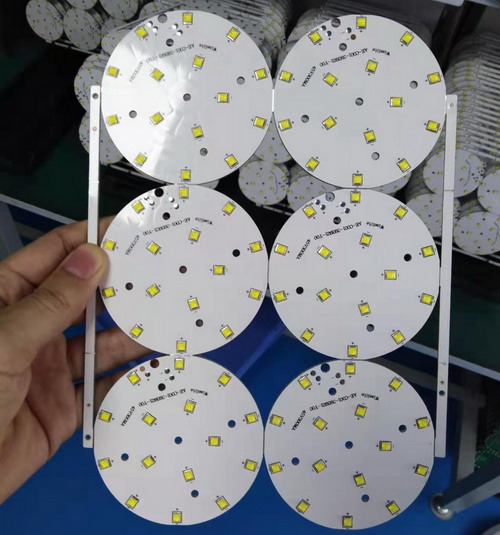
AVPCB provides LED aluminium PCB assembly services for lighting and thermal-management applications, supporting projects from PCB fabrication and component sourcing to SMT assembly, inspection and functional testing.
For LED products that generate significant heat during operation, aluminium-based PCBs provide a direct thermal path from the LED components to the metal substrate. We support custom LED PCB and PCBA projects for street lighting, automotive lighting, spotlights, signal lighting, solar lighting and other commercial or industrial lighting products.
Our one-stop service can cover PCB manufacturing, BOM sourcing, SMT assembly, through-hole assembly where required, testing and final inspection, helping customers move from prototype builds to repeat production through one manufacturing partner.
LED Aluminium PCBA Capabilities
AVPCB supports a range of PCB materials, finishes and assembly requirements for custom LED applications. The current product specifications include aluminium and copper-base thermal substrates, FR4 and other PCB materials, together with multiple surface finish and panelization options.
| Capability | Options |
|---|---|
| Primary PCB Types | Aluminium PCB, Copper-Base PCB, FR4 PCB |
| Application Focus | LED Lighting & Thermal-Management Electronics |
| Assembly | SMT, THT and mixed assembly according to design |
| Component Sourcing | BOM sourcing available |
| Surface Finish | Lead-Free HASL, ENIG, OSP, Immersion Tin/Silver and other options |
| Panelization | V-Score, Tab Routing, Breakaway Tabs, Routed + V-Score |
| Thermal Substrate | Aluminium or copper base according to thermal requirements |
| Inspection | Visual Inspection, AOI |
| Additional Testing | X-ray, Functional Testing according to project requirements |
| Production Support | Prototype to Volume Production |
AVPCB’s broader PCBA manufacturing capability includes five high-speed SMT lines, while the company lists AOI, X-ray, flying-probe and functional testing among its available inspection and testing methods.
Why Aluminium PCBs Are Used for LED Assembly
Heat management is one of the main design considerations in high-power and high-density LED products.
Compared with a conventional FR4 construction, an aluminium PCB incorporates a metal base beneath the dielectric and copper circuit layers. This structure helps transfer heat away from LED packages toward the metal base and external heat-dissipation structure.
For LED products, suitable thermal management can help address several common design concerns:
Efficient Heat Transfer
The aluminium base provides a thermal path between the LED circuit and the heat-dissipation structure, making it suitable for applications where component temperature needs to be controlled.
Compact LED Layouts
Better thermal management can allow multiple LEDs and supporting components to be integrated into compact board layouts while maintaining an appropriate thermal design.
Mechanical Stability
The metal base provides greater rigidity than a thin conventional PCB substrate, which is useful in lighting modules and other mechanically mounted LED assemblies.
Wide Range of Lighting Applications
Aluminium PCB assemblies can be configured for different shapes, LED layouts, power levels and installation environments according to the luminaire design.
Current LED-PCBA competitors also tend to organize their pages around thermal management, aluminium MCPCB assembly, SMT manufacturing and functional/optical verification, rather than simply describing generic PCB manufacturing.
LED Aluminium PCB Structure
A typical aluminium LED PCB consists of three functional layers:
Copper Circuit Layer
The copper layer forms the electrical circuit connecting LEDs and supporting components.
Copper thickness should be selected according to circuit current, thermal requirements and PCB design.
Thermal Dielectric Layer
The dielectric layer electrically isolates the circuit from the aluminium base while allowing heat to transfer toward the metal substrate.
For high-power LED designs, dielectric thickness and thermal properties are important parameters when selecting the PCB material.
Aluminium Base Layer
The aluminium base provides mechanical support and helps transfer heat from the PCB toward the luminaire housing or heat sink.
Copper-base substrates may also be considered for projects with more demanding thermal requirements.
Key Factors in LED Aluminium PCBA Design
For LED PCBA manufacturing, selecting an aluminium board alone does not guarantee good thermal performance. The complete board and assembly design should be evaluated together.
Thermal Conductivity
Higher thermal conductivity can improve heat transfer, but the appropriate material should be selected according to actual LED power density, PCB size, heat-sink structure and operating environment.
Dielectric Thickness
The dielectric layer affects both electrical insulation and thermal resistance.
A thinner dielectric layer may improve heat transfer, but voltage requirements and material reliability also need to be considered.
Copper Thickness
Copper thickness affects current capacity, heat spreading and manufacturability.
Higher-current LED circuits may require different copper configurations from low-power decorative lighting products.
LED Thermal Pad Design
For LEDs with exposed thermal pads, pad dimensions, solder paste coverage and PCB thermal paths should be considered during PCB and stencil design.
LED Polarity and Placement
LED components are polarity-sensitive. Assembly data, component orientation and silkscreen markings should be reviewed before production to reduce placement errors.
Reflow Profile
Aluminium substrates absorb and distribute heat differently from standard FR4 boards, so solder-paste selection, component packages and reflow parameters must be considered during assembly.
This is also a major point emphasized by specialist aluminium-PCBA manufacturers because metal-core substrates behave differently during reflow from conventional FR4 assemblies.
LED PCB Assembly Services
AVPCB can support different stages of an LED-PCBA project depending on your purchasing model.
PCB Fabrication
We manufacture the bare LED PCB according to your Gerber files, board outline, copper requirements, surface finish and thermal-material specification.
Both aluminium-based PCB and other substrates can be evaluated according to the application.
Component Sourcing
If required, AVPCB can source LEDs, resistors, capacitors, connectors, driver components and other BOM items for the assembly.
Customers may also provide nominated or consigned components.
SMT Assembly
Solder paste printing, component placement and reflow soldering are performed according to the approved PCB and assembly files.
LED polarity, component position and solder-joint consistency are important inspection points for LED boards.
Through-Hole and Mixed Assembly
For boards incorporating connectors, terminals or other through-hole parts, THT or mixed-technology assembly can be incorporated according to the design.
Inspection and Testing
AVPCB currently lists visual inspection, AOI, X-ray inspection and functional testing among its PCB/PCBA testing capabilities.
Testing requirements should be defined before quotation, particularly where the customer requires specific voltage, current, illumination or functional pass/fail criteria.
LED PCBA Manufacturing Process
A typical LED aluminium PCB assembly project follows the workflow below.
1. Gerber, BOM and Assembly File Review
We review PCB files, BOM information, placement data and production requirements before manufacturing.
2. Aluminium PCB Fabrication
The board is manufactured according to the specified substrate, copper structure, outline, surface finish and panel design.
3. Component Procurement
LEDs and other electronic components are prepared according to the approved BOM.
4. Solder Paste Printing
Solder paste is applied to the required component pads using the production stencil.
5. SMT Placement
LED packages and supporting electronic components are mounted according to the placement data.
6. Reflow Soldering
The assembled board passes through the appropriate reflow process to form solder connections.
7. AOI and Visual Inspection
Component placement, polarity, solder joints and visible assembly defects are inspected.
8. Additional Testing
X-ray or functional testing can be performed where required by the project.
9. Final Inspection and Packaging
Completed LED PCBAs are inspected and prepared for shipment according to the agreed packaging requirements.
Custom LED PCBA Options
Different LED products require different board layouts and thermal-management strategies.
AVPCB can review custom requirements for:
- PCB dimensions and board shape
- Aluminium or copper-base substrate
- Copper thickness
- Thermal-material requirements
- LED type and package
- LED quantity and layout
- Surface finish
- Solder mask
- Panelization method
- SMT component assembly
- Connectors and through-hole components
- BOM sourcing
- Functional testing requirements
For a new LED product, it is better to evaluate the PCB material, LED power, board geometry, heat sink and operating environment together rather than selecting the PCB solely by thermal-conductivity value.
LED Aluminium PCBA Applications
The current AVPCB page already covers a relatively broad LED-application range, including street lighting, spotlights, vehicle lighting, headlights, solar products, aviation lighting and traffic/signal lighting.
I suggest reorganizing those applications into clearer purchasing scenarios:
Street & Outdoor Lighting
LED aluminium PCB assemblies can be used for streetlights, floodlights, outdoor luminaires and other products requiring continuous heat dissipation.
Automotive Lighting
Applicable to headlights, auxiliary lighting, interior lighting and other automotive LED modules according to the required electrical and environmental specifications.
Commercial & Industrial Lighting
Suitable for spotlights, downlights, high-bay lights, panel-light modules and industrial lighting products.
Traffic & Signal Lighting
Used in traffic lights, warning indicators, signal lighting and related illuminated systems.
Solar Lighting
Aluminium LED PCB assemblies can be incorporated into solar streetlights, garden lights and standalone solar-powered illumination systems.
Medical & Specialized Lighting
Custom LED boards can also be manufactured for medical illumination and other specialized lighting equipment where the customer’s design and testing requirements are clearly defined.
Quality Control for LED PCB Assembly
For LED PCBAs, assembly quality affects both electrical operation and long-term lighting performance.
AVPCB’s quality-control workflow can incorporate:
- PCB incoming inspection
- BOM and component verification
- Solder paste inspection
- Component-placement verification
- LED polarity inspection
- Reflow solder-joint inspection
- Visual inspection
- AOI
- X-ray inspection where required
- Functional testing according to customer specifications
- Final outgoing inspection
AVPCB states that its manufacturing system holds ISO 9001:2015, ISO 14001 and ISO 13485 certifications, together with RoHS and UL-related qualifications.
Prototype to Volume LED PCBA Production
LED lighting projects often begin with engineering samples or a small pilot build before moving to repeat production.
Prototype production can be used to verify:
- PCB dimensions
- LED layout
- Component compatibility
- Soldering quality
- Electrical performance
- Thermal behavior
- Assembly compatibility with the final luminaire
Once the design and manufacturing files are approved, production can transition to larger quantities while maintaining the confirmed PCB and assembly specifications.
What to Send for an LED PCBA Quote
To evaluate an LED aluminium PCB assembly project, prepare as much of the following information as possible:
- Gerber files
- BOM
- Pick-and-place / centroid file
- Assembly drawing
- PCB dimensions
- PCB material
- Copper thickness
- Required thermal conductivity, if specified
- Surface finish
- LED model and package
- Input voltage/current requirements
- Quantity
- Testing requirements
- Any special assembly notes
If some parameters are not finalized, send the available files and target application so the manufacturability requirements can be reviewed before quotation.
LED Aluminium PCB Assembly FAQ
What is an LED aluminium PCB assembly?
An LED aluminium PCB assembly is a populated LED circuit board built on an aluminium-based PCB. The metal substrate helps transfer heat away from LEDs while the copper circuit provides the required electrical connections.
Why use aluminium instead of FR4 for LED PCBs?
Aluminium PCBs are commonly selected when heat dissipation is a major design requirement. FR4 can still be appropriate for lower-power designs or circuits requiring different electrical structures, so material selection should be based on the complete application.
Can AVPCB manufacture the PCB and assemble the LEDs?
Yes. AVPCB provides PCB manufacturing, component sourcing and PCB assembly services, allowing the aluminium PCB and LED assembly to be handled within the same supply chain.
Do you provide component sourcing?
Yes. Component and BOM sourcing are part of AVPCB’s existing one-stop PCBA service offering.
What testing is available for LED PCBAs?
AVPCB lists visual inspection, AOI, X-ray and functional testing among its available inspection capabilities. The specific test method and acceptance criteria should be confirmed according to the project.
Can you support prototype and production orders?
AVPCB’s PCBA services support projects from development and prototype stages through larger production requirements. The exact quantity, lead time and production plan should be confirmed during quotation.
Request an LED Aluminium PCBA Quote
Need an aluminium PCB assembled with LEDs, drivers, connectors or other electronic components?
Send AVPCB your Gerber files, BOM, placement data and production quantity for PCB and assembly review.